

EVP vs JVP: Why Most Hiring Teams are Pitching the Wrong Thing


EVP vs JVP: Why Most Hiring Teams are Pitching the Wrong Thing
There's a pitch most recruiting teams know by heart.
Culture. Growth. Leadership. Mission. Sometimes the office, sometimes the benefits, sometimes a line about work-life balance. It gets rehearsed for first calls, published on careers pages, and occasionally printed in offer packets.
It's the company EVP. And for a lot of the candidates you're actually competing for, it's not enough.
Not because it's wrong. Because it answers the wrong question.
A passive candidate, someone who's employed, performing, and has real options, isn't primarily asking "why should I join your company?" They already have some answer to that, or they wouldn't be in the conversation. What they're actually weighing is something more specific: "Why is this job, at this team, right for me right now?"
That's a different question. Most hiring teams don't have a ready answer for it. This article is about why that gap exists, what it costs, and how to close it.
Company EVP vs. Job Value Proposition: two different purposes
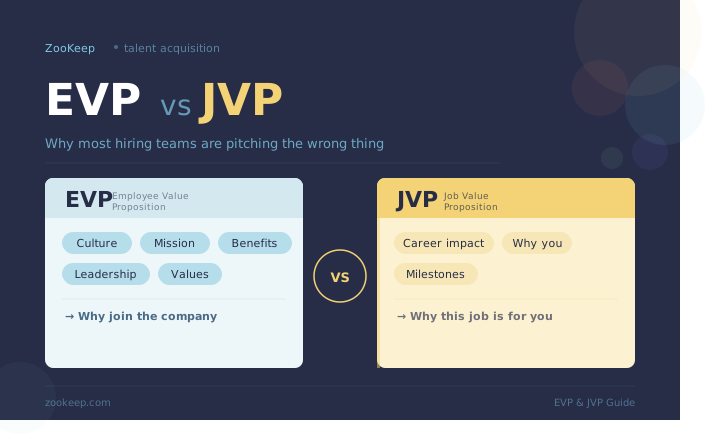
The EVP (Employee Value Proposition) belongs to the organization; it's a starting point to say who you are as a company. It answers: Who is this company as an employer? What kind of person does well here? What's the working culture, the pace, the expectations, the style of leadership?
A strong EVP is honest and specific enough to attract certain people and put off others. That's the point. A company that competes hard, rewards top individual performance, and runs at high intensity should say so. A company that prizes deep thinking, collaborative decision-making, and deliberate execution should say that. The EVP is the first filter, it tells prospective candidates whether your organization is the kind of place they want to work.
It also has to stay consistent. An EVP that shifts based on who you're recruiting isn't an EVP, it's a sales pitch. If the company sounds different to a VP-level candidate than it does to a mid-career engineer, one of those conversations isn't accurate. Candidates compare notes, talk to former employees, and check LinkedIn. Inconsistency gets found out. When it does, it damages the trust you need to close good hires.
The JVP, the Job Value Proposition, is different in kind, not just degree.
It belongs to the role. It answers: why is this specific job, on this specific team, at this specific moment, the right opportunity for you?
Take a fast-growing B2B sales company. Their EVP is clear: high energy, commercially driven, strong upside for top performers. A certain kind of person finds that compelling. Now that same company is hiring a software engineer. The EVP doesn't answer what the engineer actually needs to know. Are engineers treated as strategic partners or a support function? Does the technical roadmap get reprioritized by sales requests every quarter? Is there a senior architect or is this person the most experienced technical hire on the team? Is there real autonomy over technology decisions?
The JVP answers all of that. It says: here's what's true about this job, this team, this manager, and here's why it's right for someone like you.
The test: An EVP should make someone think, "This company is for me." A JVP should make them think, "This job is for me." You need both. One without the other leaves a gap that a strong candidate will notice.
What a real JVP contains
Before a recruiter sends the first outreach message, and certainly before an interviewer opens their first call, there are five things your team should be able to articulate clearly about the role. If you can't answer these, you're not ready to recruit.
The hiring manager's working style. A new hire isn't just joining a company. They're joining a specific manager. How that person communicates, gives feedback, delegates work, and handles pressure shapes the day-to-day experience more than almost anything else. A manager who expects experienced hires to operate independently is the right fit for some people. A manager who gives detailed context and checks in regularly is the right fit for others. Neither is wrong, but candidates deserve to know which one they're walking into.
What the team's day actually looks like. Not the polished version. The real one. Is this a team that moves fast and course-corrects, or one that takes time to get things right before releasing? Are there long, focused work blocks or frequent context switching? How are decisions made, by the team, or by leadership? This kind of specificity signals something important to a candidate: that your team actually knows the role and isn't just filling a seat.
The deliverables, defined specifically. What does a successful 30-60-90-day period look like? If the hiring team struggles to answer that clearly, it usually means the role definition work hasn't been done properly, which is a problem that will show up in every candidate conversation. Strong candidates ask this question early. Vague answers register as a red flag, not just a gap in information.
What the person will genuinely gain. Not "career development opportunities." That phrase means nothing. Specifically: what skills, relationships, business exposure, or career capital will someone in this role actually acquire? What does it set them up for in two or three years? This has to be honest and specific to the role, not copied from a job description template.
Why now. What's the context that makes this moment meaningful? Is the team scaling into a new product area? Rebuilding after a restructure? Entering a new market with resources finally behind it? The "why now" element is often what converts a passive candidate from interested to moving. It creates a sense of opportunity without pressure, which is exactly what you need when competing for someone who doesn't have to leave their current job.
One addition that consistently works: a day-in-the-life example. Not a marketing narrative. An honest, specific description of what someone in this role actually does on a regular day. It gives candidates a real basis for self-assessment, and it signals to them that your team understands the job well enough to describe it that way.
What a weak JVP actually costs, especially in Japan
In any competitive talent market, a weak JVP loses you candidates. In Japan's specialized role market, it can end a process before it's meaningfully started.
A few things about Japan's recruiting environment make the stakes higher.
The talent pool for niche roles is genuinely small. For certain senior commercial, technical, or bilingual professional roles, you might be looking at a few hundred qualified people in the entire country. There's no volume to absorb the drop-off caused by a poorly communicated role.
Trust is not assumed, it's built, or it's absent. Changing jobs in Japan carries real professional and social weight. For experienced professionals in stable employment, leaving a known organization for an unknown one is a meaningful decision. The hiring process is the first concrete evidence of whether that risk is worth taking. Every touchpoint generates a signal.
What that means practically: a recruiter who can't answer basic questions about the team is a signal. An interviewer who is vague, evasive, or visibly unprepared is a signal. A process with no transparency on timeline, evaluation criteria, or who makes the final decision is a signal. None of these signals are good, and in a market where trust is the primary currency of a hiring decision, they compound.
There's a real distinction between the two types of candidates. Those who need a new job will tolerate a disorganized process and sell themselves through it. Those who could take a new job, which is generally who you're competing for at the experienced professional level, are evaluating your organization as much as you're evaluating them. For them, a process that can't clearly answer "why is this job right for me?" isn't just forgettable. It's a reason to disengage.
Here's what the funnel typically looks like when the JVP is missing: outreach response rates are low because the opportunity sounds identical to everything else in the market. First-round dropout is higher than it should be because early questions surface gaps that the recruiter can't address. Late-stage ghosting increases because candidates who stayed in out of professional curiosity eventually compared options and chose the employer that gave them the clearest, most specific story.
The cost is rarely just the lost candidate. It's the sourcing hours, the interviewing panel time, the agency fees if applicable, and on top of that, the opportunity cost of the role staying open longer than it needed to.
One EVP. As many JVPs as you have roles.
A question that comes up: if you're building a separate JVP for every role, doesn't the company's message become inconsistent?
No, and the distinction is important.
The EVP stays constant because it represents the organization. If it changes depending on who you're recruiting, it stops functioning as an EVP and starts functioning as a pitch, which candidates, especially experienced ones, will usually recognize. Consistency builds trust. Changing the story by the audience breaks it.
The JVP, on the other hand, should be built fresh for every search. Because what makes a job genuinely compelling is different depending on who you're talking to, and what matters to them.
A senior engineering manager and an early-career product designer are weighing almost entirely different things. The designer wants creative ownership, exposure to product decisions, clear feedback, and a team whose work they find meaningful. The engineering manager wants organizational autonomy, influence over technical direction, strong colleagues they can develop, and confidence that decisions made at their level will actually be implemented. The company EVP might speak to both. Neither of them is primarily moved by it.
The same principle holds within functions. Two software engineers in the same candidate pool may have completely different priorities, one is optimizing for technical depth and mentorship, the other for ownership and broad business impact. A well-built JVP can speak to the right one. A generic role description speaks to neither.
When the same pitch gets used across all roles and all candidates, the opportunity being wasted is real: the moment when a strong person is actually considering whether to move.
Where EVP and JVP fit in the recruitment value chain
EVP and JVP don't exist in isolation from the rest of the hiring process. They connect and either reinforce or break every stage.
At ZooKeep, we think about recruitment as five interconnected value chains. Here's where EVP and JVP have the most impact in each.
The Role Definition Chain (business objective → headcount plan → role specification → success criteria → interview design)
This is where the JVP is either built or isn't. If the role definition process doesn't ask "who is this job specifically right for and why?", the JVP never gets established. What you get instead is a job description that optimizes for completeness over specificity, and an interview process that can assess technical fit but has no ability to compel someone to actually accept the role.
The Pipeline Chain (employer brand → talent database → sourcing → candidate engagement)
This is where the EVP lives. Your employer brand is only as strong as how clearly it communicates who you are as an organization. Sourcing outreach, whether direct, referral, or through an agency, converts better when the opportunity is framed specifically: why this role, why now, why for someone like you. Without a JVP, outreach becomes interchangeable with every other message a target candidate receives. That's a problem when you're competing with someone who has options.
The Evaluation Chain (screening → structured assessment → interview calibration → decision quality)
This is where JVP breaks down most visibly. The most common failure: an interviewer who can't describe what success looks like in the role, or who can't answer a candidate's questions about the team with any real specificity. This isn't just a missed opportunity to sell, it's a trust signal. In Japan, particularly, this is often the moment a process quietly dies, not with a formal rejection but with the candidate going quiet.
The Candidate Experience Chain (first touchpoint → process transparency → interview experience → offer design → onboarding)
The JVP needs to run through this entire chain. At the first touchpoint, it creates the hook. Through the process, it deepens and becomes more specific. At the offer stage, it closes. Organizations that lose candidates late in the process, after real investment on both sides, almost always find the same root cause: the JVP was never specific enough to make the final yes decision easy.
The Learning & Maturity Chain (data capture → analytics → retrospectives → capability improvement)
Most teams don't systematically track why candidates declined, withdrew, or stopped responding. If they did, EVP and JVP gaps would consistently rank among the top causes, often ahead of compensation and well ahead of sourcing volume. Closing this loop is what turns a reactive recruiting function into one that actually improves over time.
What to do next
If your self-assessment score at the top of this page was below 12, the gap is real and worth closing before your next significant search.
The work doesn't require a large project. It requires a consistent habit: before any role opens, your team should be able to answer five questions about the job, the hiring manager's style, what the day looks like, the 90-day deliverables, what the person gains, and why now. That's the JVP. It takes an hour to build properly, and it changes every candidate conversation that follows.
If you'd like to talk through where your hiring process is breaking down, the ZooKeep team works directly with talent acquisition and HR leaders on exactly this kind of structured foundation work.
[ Book a conversation ↓]
This article was written by the ZooKeep team. ZooKeep works with talent acquisition and HR leaders in Japan and across APAC to build structured, sustainable hiring processes, from role definition through to offer acceptance.