
Tokens, Teams, and the New Org Chart: A Fireside Chat With Nikos Michalakis and Jordan Jarjoura


A conversation between Nikos Michalakis and Jordan Jarjoura, moderated by Fuminori Gunji, ZooKeep
Nikos Michalakis is a technology executive, leadership coach, and change facilitator who has spent 20+ years turning software into a business advantage, from Netflix's platform engineering team to building a 500-person engineering organization from scratch at Toyota. He holds 20+ patents spanning autonomous driving, robotics, and vehicle software, and an MIT degree in Electrical Engineering and Computer Science. Now a fractional CTO and executive coach, Nikos advises companies on how to structure technical organizations for the AI era, drawing on firsthand experience scaling teams across Silicon Valley, Japanese manufacturing, and Swedish telecom cultures. Jordan Jarjoura previously led engineering staffing for Google Japan and Korea and built embedded talent solutions before becoming ZooKeep's Head of Product, a vantage point that sits directly at the intersection of org design and the talent pipeline that has to staff it.
In this fireside chat, hosted by ZooKeep, Nikos and Jordan pick apart what's actually changing underneath the "AI is disrupting the org chart" headline: not just how work gets done, but who gets hired, how their manager survives, and how a CFO who's never had to budget for a "hybrid workforce" is supposed to start.
Key Takeaways from This Conversation |
The pyramid loses to the budget-holder. A single senior person with their own budget for contractors and AI is starting to outperform the traditional lead-plus-mid-plus-junior stack, but in large enterprises, resisting a smaller team is still a political move, not a performance one. |
Flat AI budgets don't work. Usage follows a power law, a few people account for most of the spend, so a flat per-person allowance is wrong for almost everyone. Nikos's fix: plan hiring and AI spend together, against work shipped, not against headcount or tokens in isolation. |
"Junior plus AI" is an enterprise trap. Pairing a junior hire with AI to avoid the cost of a senior one usually fails, not because the AI is bad, but because juniors often can't validate its output, and that gets read as "AI doesn't work." |
Managers are being squeezed, not replaced. The real risk isn't obsolescence, it's babysitting a mediocre AI output and a demotivated direct report at the same time, multiple times a day. |
Enterprises should pilot small, not mandate big. Two time-boxed, three-month pilots, one product, one ops, beat a company-wide AI mandate, especially in risk-averse markets like Japan. |
The "elite engineer" of the future may never write code. Success shifts to orchestrating hundreds of scoped, cost-aware AI agents, a description that lines up closely with what Nikos calls "Captain Human" on his own Humanness Scale framework. |
The Pyramid Is Dead, the Budget Is the New Org Chart
Why a single senior person with a budget is starting to replace the lead-plus-mid-plus-junior stack, and why large enterprises resist doing the same thing
Jordan, you sit at the intersection of talent strategy and org design. What's actually changing in how companies plan headcount for something new?
Jordan: I was recently on a call with an enterprise client doing standard headcount planning, what's next year's goal, are we increasing sales by fifty percent, are we shipping a new product. The old model was automatic from there: assign a lead, add a couple of mid-level people, add some juniors to execute. That conversation is disrupted now. It's less "who executes this" and more "does one person with their own budget for contractors do more than that whole pyramid used to?"
There's a politics problem sitting underneath it, too. If you're a small company, a lean team is fine. If you're a thirty-thousand-person enterprise, having a smaller team can actually work against you internally, because headcount is still currency for a lot of people, they want a bigger team under them regardless of what it does for the business. There's a real disconnect between "more people" and "better product," but plenty of orgs are still structured as if the two are the same thing.
Nikos, you're running that experiment on yourself right now. What does your own team actually look like?
Nikos: I'm effectively the architect, head of product, and head of engineering at once, with five or six junior engineers and a couple of contractors under me. That only works because of how AI sits inside it, I set the standard for what good code looks like, AI does the first-pass review, and the junior engineer works from what comes back. Progress isn't measured in headcount for me. It's work done, problems solved, product shipped, revenue increased. Tokens or people is just implementation detail underneath that one number.
But there's a real stakeholder gap behind this that most companies haven't closed. CFOs are getting AI bills way above what they expected. Working with AI is genuinely addictive once you start shipping more, because it makes you look good, so usage keeps climbing. HR needs to figure out what the workforce looks like, finance needs to figure out what the AI bill looks like, and almost nobody's put those two conversations in the same room yet.
CHRO meets CAI. A handful of companies have already merged the head-of-HR and head-of-AI seats into one role, Fuminori pointed to Moderna as one example, with Line making similar moves. Nikos's read: somebody has to own the accounting for both halves of the workforce, human and AI, or the two budgets never talk to each other.
Treat AI Spend Like Headcount, or Why CHRO and CIO roles start converging
The power-law problem behind flat AI budgets, and why almost nobody asks "cost per AI" the way they ask "cost per hire"
What's actually broken about how companies budget for AI today?
Nikos: The default move is a flat per-person allowance, say, fifty dollars a month per employee. It doesn't work, because usage follows a power law: a handful of power users burn through everything, most people barely touch it, and the flat number is wrong for nearly everyone. I have control over my own budget, this month I might spend heavily because I'm working through a specific set of problems, next month less because we're mostly in a design phase. Hiring and AI spending should be planned together, by HR and finance, against the same yardstick: work done, not tokens burned.
Jordan: What strikes me is we've spent decades building HR around cost-per-headcount and the performance of that headcount, because it's the biggest line item in the business. Nobody's built the equivalent discipline for AI yet. You could have one team completely wasting spend with no review happening, and another team spending half as much and actually getting value from it, and the CFO has no way to tell the difference. With headcount, if something isn't performing, you cut it and reallocate. Nobody's doing that review for AI consumption yet.
Nikos: Part of the fix is just making the cost predictable in the first place. You don't always need the most expensive frontier model, plenty of routine work runs fine on open-source models, on flat-rate tools with effectively unlimited usage, or on infrastructure billed by the hour instead of by the token. My own product generates board-ready PowerPoint reports from dashboards using an open-source model, something that would have been unthinkable to build quickly a couple of years ago. Companies rarely even look at these as real options.
Zutip: turning planning into a number you can check your work against. Instead of estimating projects by vague voting or gut feel, Nikos's team started feeding a full feature list to an LLM and asking for a straight man-hours estimate, then planning and checking progress against that number as they went. A side effect he noted: LLMs themselves plan better and hallucinate less when they're forced to build a plan first, estimation discipline helps the AI as much as it helps the humans reading the estimate.
The Manager Gets Squeezed From Both Sides
Why pairing a junior hire with AI to save the cost of a senior one usually backfires, and what it does to whoever's stuck managing both
Where does this actually go wrong?
Jordan: The pattern I see across companies: hand a junior person some form of AI and assume it replaces the need for a senior hire, to save cost. Then the experiment fails, and the conclusion becomes "AI doesn't work", when really, there were no real controls on the experiment in the first place. Experiments are only as good as their controls. A senior person can look at a bad AI output and know it's bad. Hand the same output to someone junior, and a lot of the time they'll just assume the AI knows better than they do, because they can't validate it either way.
Nikos: And if the AI doesn't actually know better, that becomes the manager's problem. You end up dropping down multiple levels to micromanage, an engineer submits a feature, the automated code review comes back full of gaps, and now I have to figure out which gaps are serious, decide whether to trust the person to fix them, then go have the conversation. That's babysitting. You're managing the AI's output and the human's motivation at the same time, and it's a real context-switching cost. Before AI, you could tell two people to go figure it out and walk away. Now results come back multiple times a day, and you can't.
Jordan: If the guardrails already exist, code review standards, design patterns, all of it, then pairing more junior, execution-focused people with AI can work fine. If that infrastructure doesn't exist yet, you're much better off bringing in a senior person who can build the guardrails and self-approve, rather than hoping a junior-plus-AI pairing invents them on the fly.
"The thing I didn't expect would happen is that I would personally be feeling very much alone. I don't have another senior person to be a sounding board, to fight back with me.",
Nikos, on the tradeoff of building lean teams around junior contractors and AI
Enterprise Adoption Without the Big Bang
A pragmatic three-month experiment for risk-averse organizations, and the trap of piloting AI somewhere it can never get absorbed back
Fuminori: You (Jordan) and Nikos both know Japan's reputation for being risk-averse about exactly this kind of change. How does a large Japanese enterprise actually start?
Jordan: It's a real question for me. Startups can just experiment. But how do you get a large, established company to feel comfortable saying "we should take a risk here" when nobody knows how it'll turn out?
Nikos: Large teams respond better to KPIs and OKRs than to an abstract mandate to "use more AI." If a CFO or CPO picks a metric they want moved this quarter, faster forecasting, tighter planning cycles, whatever it is, teams find their own way to hit it with AI, and that works better than a top-down instruction with no target attached. My concrete advice: pick two very different projects, one product-focused and one pure ops, time-box both to three months, and see where AI actually helped and where it didn't. That gives you real data instead of a hunch.
Fuminori: What I see a lot in Japan is companies running these experiments inside a separate new business or innovation unit, deliberately outside normal HR and IT policy, so that if it goes wrong it doesn't touch headquarters.
Nikos: The risk with that approach, in my experience, is that that kind of a “satellite team” almost never gets absorbed back into the main HQ org. Even with a fully proven result, the reaction is usually "that's not the same as us", even when it is. My advice for a big enterprise either way: start now, because every quarter you wait, you fall further behind whoever already did. And let directors and managers pick their own recipe. A five-hundred-person org doesn't behave like one monolithic team; different areas will want to adopt differently, and that's fine.
Fuminori: Even before "how do we use this as a team," a lot of Japanese companies are stuck earlier than that. Everyone's already using Claude or Gemini individually, but there's no shared team-level usage, and the IT security department often won't sign off on rolling anything out at the business unit let alone company level at all. What is your take on this issue?
Nikos: One low-risk starting point: have IT stand up things that were never really a "should we do this" decision in the first place, a scheduled job that scans documentation for gaps, for instance. It's inherently predictable in cost, because it's just a job that runs on a timer, and it doesn't require getting the whole company to agree on anything first.
Garbage collector agents idea:
One idea Nikos returned to more than once during this conversation: background agents that run on a schedule, Friday night, say, scanning whatever a team produced that week and surfacing conflicts or gaps across departments before Monday's meetings. The pitch: it replaces some of the alignment that used to require constant check-ins, without needing company-wide buy-in to start.
The Captain, the Crew, and the Elite Engineer of the Future
Why the best engineers of the next decade may never write a line of code, and how it echoes Nikos's own framework for measuring human-AI collaboration
Fuminori: Where does this all head longer term? What does a great employee even look like once this settles?
Jordan: I keep coming back to a kind of symbiotic pairing. You can identify someone who's great at task management but weak on creativity, and lean the AI toward covering the creative gap rather than the task-management side. It's cyborg-like, I have a bad knee, and a knee brace helps. If someone's weak on time management and AI helps compensate, that's not cheating. It's just a more balanced worker.
Nikos: That already has a name, Ethan Mollick calls it cyborgism, where the human and the AI genuinely merge on a task rather than one just handing off to the other. I'd add that leadership needs to make this normal to talk about. CHROs should be telling people, openly, company-wide, that sharing how you use AI isn't something to hide, it shouldn't count against anyone in a review.
Fuminori: What does that do to what a "senior (personnel)" even means going forward?
Nikos: I think the elite engineer of the future doesn't write a single line of code. What they do is orchestrate hundreds of AI agents, each one scoped to a task and a cost, sequenced so the output of one triggers and validates the next, an execution graph with safety and validation gates built in, something a regular engineer would find impossible to manage by hand. We used to measure elite versus junior engineers by how much more complexity the elite ones could hold in their heads at once. That gap is moving to the agent layer: a junior engineer runs one agent at a time; an elite one runs a hundred, in the same day, with the guardrails already built in.
That reframes the metric for a "superstar" employee, too: whoever can run the most agents, at the lowest cost, producing validated work the fastest. Not who has the best title. That's where the career value is moving.
The Real Question Underneath All of This
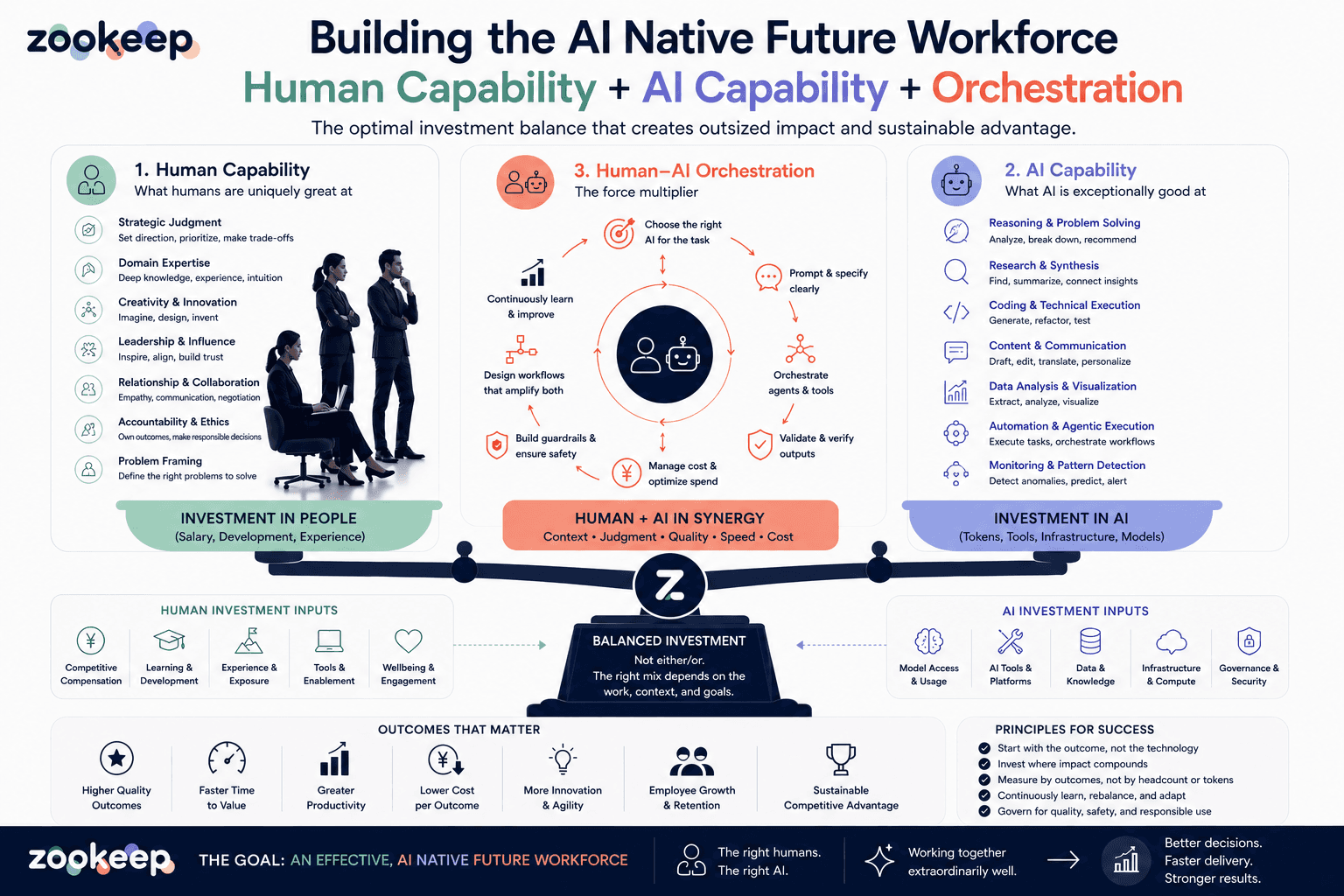
Across the conversation, one central question keeps resurfacing in different disguises: how much and what kind of a company's work should be taken care of by people, and how much and what by gen AI or tokens, and who's actually accountable for finding the right balance. Jordan's opening framing, the CFO's unpredictable AI bill, the business unit manager babysitting whether his subordinates uses gen AI in a sensible way, the enterprise stuck between an innovation unit and headquarter policies, the "superstar" employee who runs the multiple agents in a cost efficient way, all of it circles back to the same unresolved line item.
Nikos's answer is structural: fold hiring and AI spend into one number, measured against work shipped, not against headcount or token count in isolation.
Jordan's answer is cultural: the org chart survives, but only for the people who can prove the AI-augmented version of their role is actually worth what it costs.
Neither thinks the org pyramid disappears overnight. But both agree it stops being the default, and that the companies that work out how to price the human-AI mix first, rather than the ones that adopt the flashiest model first, are the ones that end up ahead.
About the Speakers
Nikos Michalakis, Fractional CTO | A technology executive, leadership coach, and change facilitator with 20+ years turning software into a business advantage, from Netflix's platform engineering team to building a 500-person engineering organization from scratch at Toyota. Holds 20+ patents across autonomous driving, robotics, and vehicle software, and an MIT degree in Electrical Engineering and Computer Science. Now advises companies on structuring technical organizations for the AI era. |
Jordan Jarjoura, Head of Product, ZooKeep | Previously led engineering staffing for Google Japan and Korea and built embedded talent solutions before joining ZooKeep. Sits at the interface between org structure and the talent pipeline that has to staff it. |
Fuminori Gunji, GTM Advisor, ZooKeep | GTM advisor at ZooKeep, overseeing the company's interview series and thought leadership programs. |
— ZooKeep Marketing